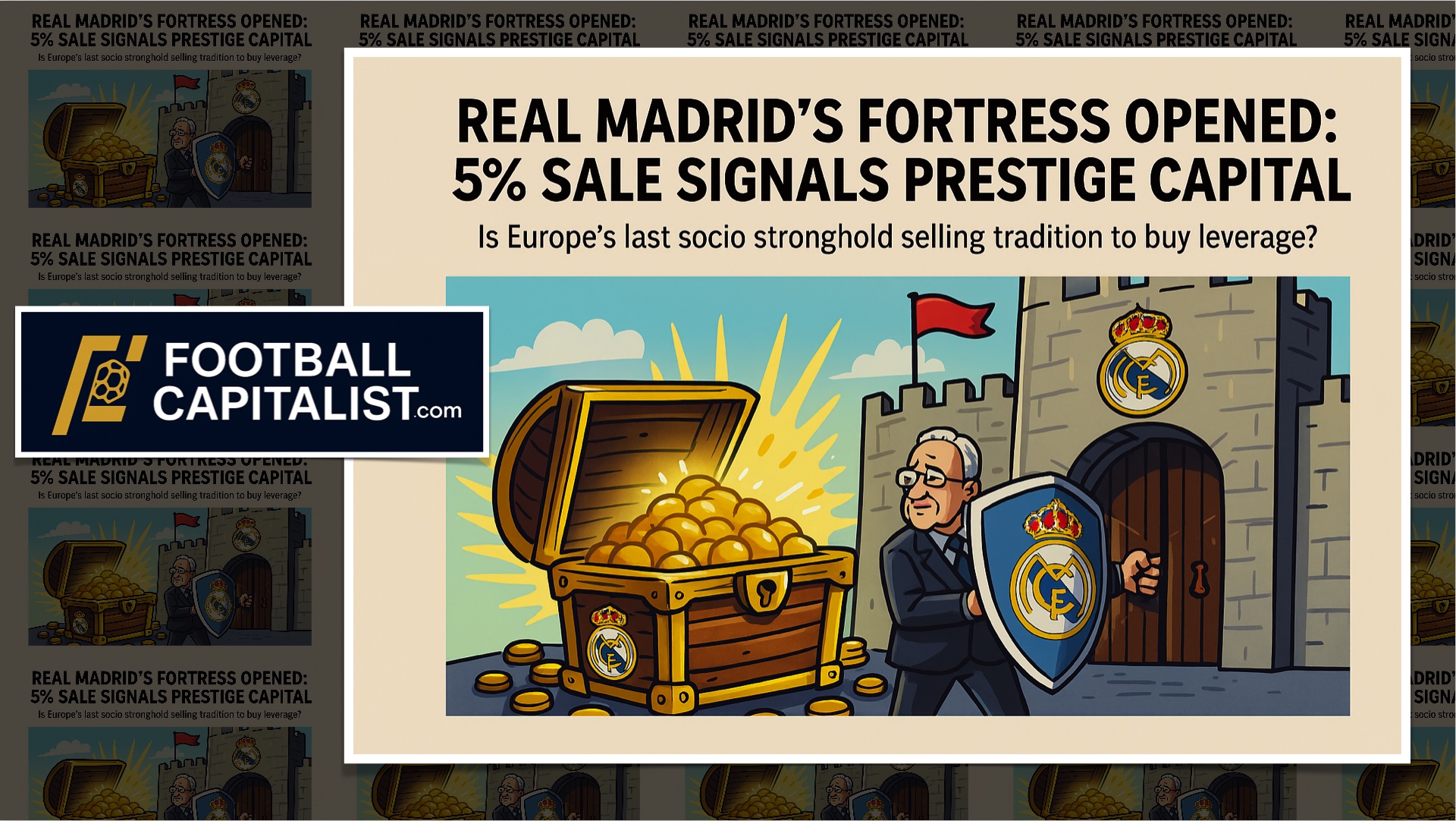
Symbolic capital or defensive hedge? Real Madrid’s 5% sale blurs the line between community identity and market leverage, raising precedent risks for Barcelona and Bayern.
Real Madrid’s historic plan to sell a 5% stake marks a dramatic evolution for the 123‑year‑old club, signaling the opening of Europe’s last great football fortress to external investors. For the first time, the iconic, member‑owned giants are moving away from purely socio‑controlled ownership toward a hybrid structure that could unlock new capital while preserving the essence of the club for its 100,000 socios.
The proposal involves establishing a new subsidiary company wholly owned by the members, through which a minority equity stake will be sold to “strategic allies.” These investors would receive dividends but no voting rights or governance power. President Florentino Pérez has emphasized that socios will maintain full control, retaining the one‑member, one‑vote structure and the ability to elect leadership. In short, governance remains sovereign, even as capital markets are invited in.
Financially, the move is not about plugging holes. Madrid posted record revenues of €1.185 billion in the 2024/25 season, with healthy EBITDA margins and negligible debt. Yet the demands of competing with state‑backed clubs and financing the Bernabéu’s billion‑euro transformation require fresh strategies beyond traditional revenue streams. A 5% sale provides a valuation benchmark—placing Madrid’s worth at roughly $6.75 billion—and a mechanism for capital injection without ceding control.
For investors, the stake is symbolic. It offers exposure to football’s most valuable brand, but no influence over its direction. For Madrid, it is a flex: monetizing aura while preserving sovereignty. The prestige of owning even a sliver of Real Madrid may attract luxury conglomerates, private equity, or consortium investors, but the real prize is association, not power.
Yet symbolism cuts both ways. By setting a market valuation, Madrid opens the door to future dilution. If Europe’s last bastion of member control cracks open, Barcelona and Bayern Munich may follow, reshaping football’s ownership landscape. What begins as a tightly controlled gesture could evolve into a precedent that erodes socio exclusivity.
This is where the contrarian lens matters. Is the 5% sale prestige capital—a calculated move to monetize aura and strengthen Madrid’s independence—or panic capital, a defensive hedge against sovereign wealth rivals? Either way, the deal blurs the line between community identity and market logic. Real Madrid is not selling control, but it is selling tradition, and in doing so, it signals the dawn of a new era in football capitalism.